Custom manufacturing
Heavyweight T-Shirt Manufacturer — 240–320 gsm
The single most common complaint about a light T-shirt is that it is see-through and clings. That is a fabric-weight problem, not a fit problem, and it cannot be fixed by sizing up. Going from 160 gsm to 240 gsm roughly doubles the yarn mass per square metre: the garment holds its own shape instead of the body's, the collar keeps a clean line, and a print sits on a flat surface rather than telegraphing through. We build heavyweight programmes from 240 gsm up to 320 gsm, and we will tell you when a heavier fabric is the wrong answer.
500 pcsMinimum order
7–10 daysSampling
180,000 pcs / monthMonthly capacity
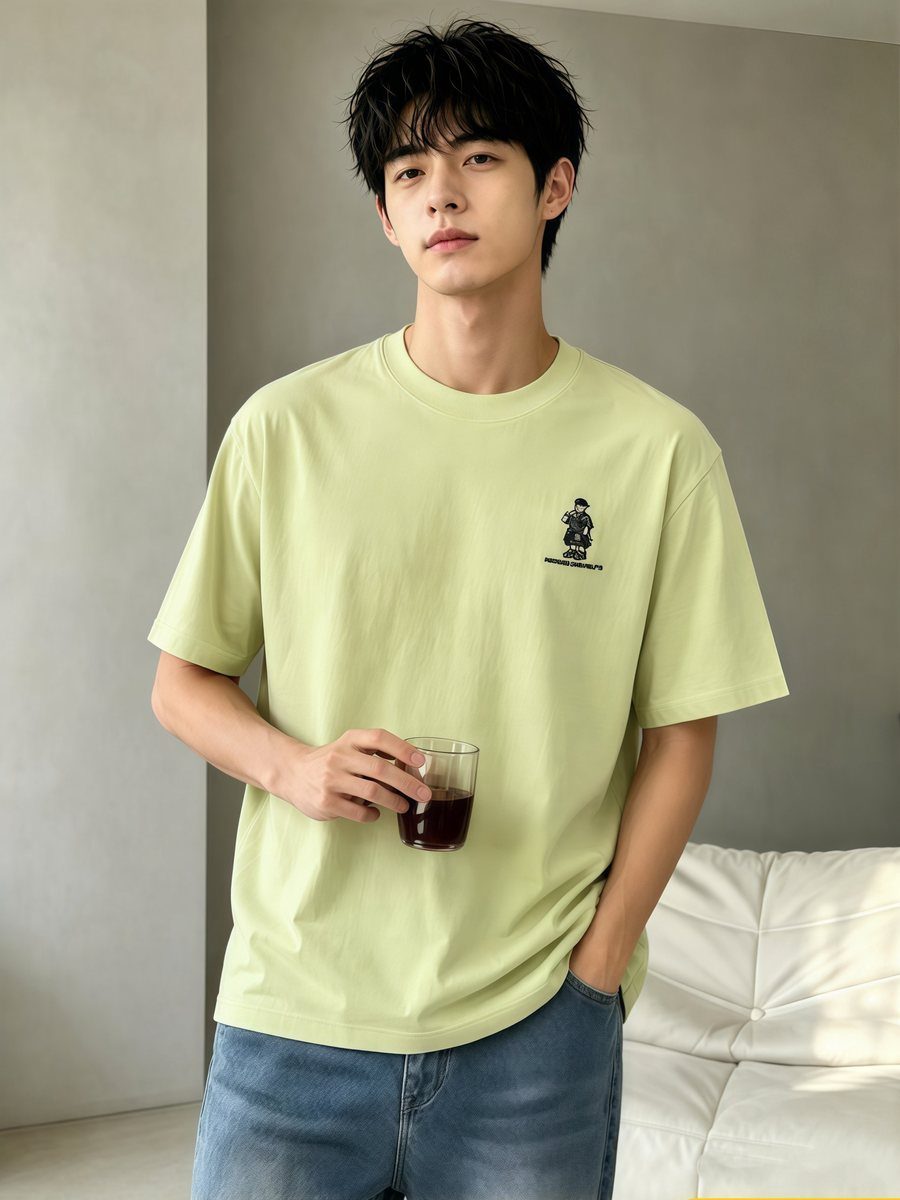
Fabric weight and construction options
| Weight / type | Material | Best suited to |
|---|---|---|
| 240 gsm | Combed cotton, compacted jersey | Premium basics — the entry point for heavyweight |
| 260 gsm | Ring-spun cotton, tight gauge | Streetwear staples, retail-ready hand-feel |
| 280 gsm | Heavy interlock or double jersey | Boxy oversized fits, drop-shoulder cuts |
| 300–320 gsm | Heavy loop-back jersey | Statement pieces, skate and workwear crossovers |
| 240–280 gsm | Cotton–poly blends (65/35) | Lower shrinkage, lower cost, print-first programmes |
Available decoration methods
| Method | Specification | Typical use |
|---|---|---|
| Screen printing | 1–8 colours | The best surface for ink — a flat, heavy face with no show-through |
| Puff print | 2–4 mm raised ink | Holds dimension far better on a heavy fabric than a light one |
| High-density / HD | Near-zero thickness, sharp edge | Crisp logo edges; needs a dense weave to hold detail |
| Embroidery | Up to 12 colours | A 280 gsm body carries a heavy stitch count without puckering |
| DTG / DTF | Full colour, no minimum | Works, but the ink sits on top — best on 100% cotton |
Specifications we manufacture to
- Fabric
- Combed and ring-spun cotton, cotton–poly blends, heavy interlock
- Weight range
- 240 – 320 gsm
- Sizes
- XS – 5XL, or your own graded size chart
- Fit
- Regular, boxy, drop-shoulder, longline
- Neck
- Ribbed crew (double-stitched), V-neck, mock neck
- Shrinkage
- Compacted to ≤3% if pre-shrunk is specified at sampling
- MOQ
- 500 pcs per colourway
- Sampling
- 7–10 days
Decoration methods for this product
Related product categories
Frequently asked questions
Why is a heavier T-shirt more expensive?
You are buying more yarn per garment — a 280 gsm tee uses roughly 75% more cotton than a 160 gsm tee in the same size. The fabric cost, not the sewing, drives the price. Expect the unit cost to track the weight almost linearly.
Does a heavier fabric shrink more?
Not necessarily, but it has more mass to move. A 280 gsm uncompacted cotton can lose 5–7% on the first wash, which is enough to break a size chart. Specify compacted or pre-shrunk fabric at the sampling stage — it cannot be retrofitted after bulk production.
Will embroidery pucker on a heavy T-shirt?
Less than on a light one, which is one reason heavyweights suit branded programmes. The risk moves to the opposite problem: a very dense fabric plus a high stitch count can make a stiff patch. We use a suitable backing and cap the stitch count for the fabric weight.
Can you match the heavyweight fabric of a brand I already sell?
Yes. Send the garment and we will measure the gsm, count the yarn, identify the knit structure and the finish (compacted, mercerised, garment-dyed), and quote to reproduce it. We will flag any component that is proprietary to that mill.